I’m Home. Time to Unpack. Why Your Child Falls Apart After School
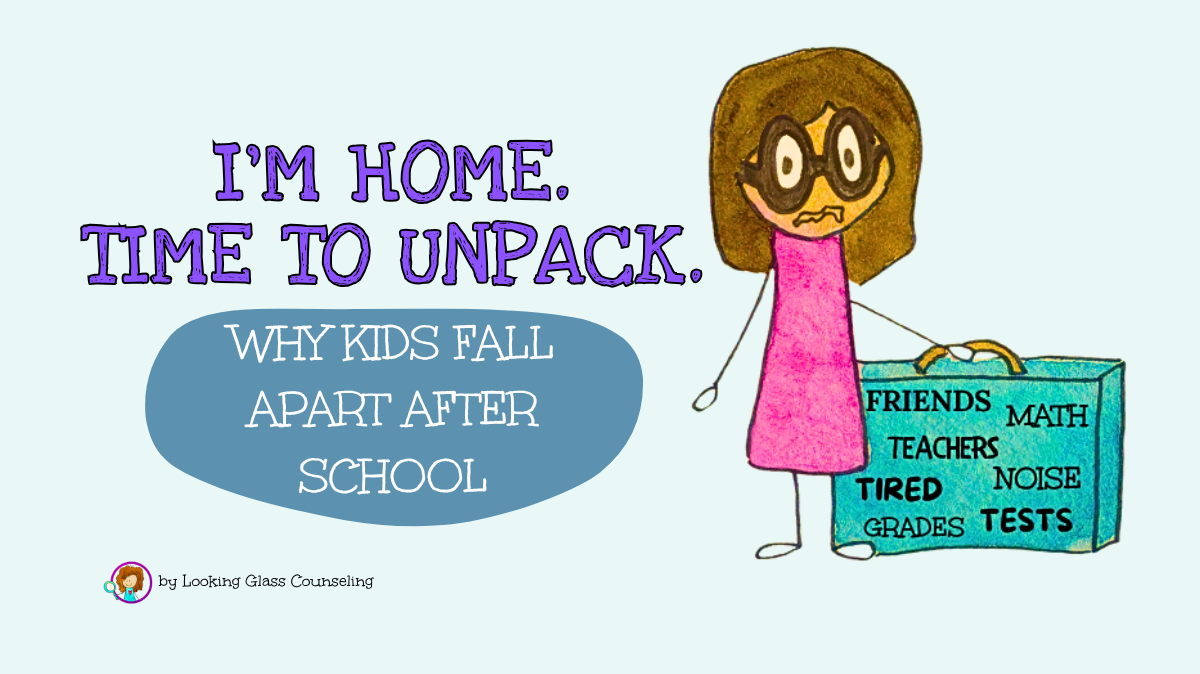
What after-school meltdowns may be communicating—and how to help your child transition before correcting the behavior.
Have you ever found yourself thinking, Are you sure we’re talking about the same child? when the teacher tells you your child had a great day?
They followed directions, completed their work, got along with classmates, and held everything together from the moment they entered the classroom until the final bell rang. Yet somewhere between the classroom and the car, something seems to change. They get into the car, walk through the front door, or hear one simple request from you—and everything falls apart.
Their sibling looked at them the wrong way. The snack broke in half. The wrong cup is sitting on the counter. You asked how their day was. You reminded them about homework. Suddenly, the child who apparently managed school all day is crying, yelling, arguing, shutting down, or reacting as though the smallest inconvenience is unbearable.
Parents are often left wondering, Why can they behave at school but not at home? Are they saving their worst behavior for me? Am I doing something wrong? Are they manipulating me because they know I’ll put up with it? Probably not. The behavior may be telling you that your child used a significant amount of energy getting through the day—and arrived home with very little left.
A Good School Day Can Still Be a Demanding Day
When adults hear that a child had a “good day,” we tend to assume the day was easy. But a good report usually tells us how the child behaved. It does not tell us how much effort that behavior required.
Throughout a typical school day, children may be expected to follow multiple directions, move through frequent transitions, sit still when their bodies want to move, ignore distractions, manage noise and sensory stimulation, wait their turn, read social cues, cope with disappointment, recover from mistakes, keep track of materials, navigate friendships, control impulses, and adjust to unexpected changes. They may also have to complete tasks they find difficult or uninteresting while asking for help in ways adults consider appropriate.
A child may do all of this successfully and still come home emotionally depleted. Success does not mean the effort was small. Sometimes it means the child worked extremely hard to meet the expectations placed on them.
Stress Does Not Always Stay at School
Research on the daily experiences of children and adolescents has found evidence of what is sometimes called school-to-home spillover. Problems, pressure, and negative emotions experienced during the school day can carry into home life and affect a child’s mood, behavior, and interactions with family members later that day.
This does not mean every after-school outburst was caused by something terrible happening at school. It means children do not walk through the front door with a completely reset nervous system. They bring the day with them.
A frustrating assignment, embarrassment in front of classmates, social uncertainty, sensory overload, a schedule change, worry about performance, or the repeated effort of controlling impulses can accumulate. The final trigger at home may appear small because it is not the whole story. You’ve heard the phrase the straw that broke the camel’s back. Sometimes something as small as, “There are no more Oreos,” is enough to send the whole house into code red.
“They Were Fine Until They Got Home”
You may hear this pattern described informally as after-school restraint collapse. It is not a clinical diagnosis. It is a relatable way of describing what can happen when a child contains emotions and behavior throughout a structured school day, then releases them after returning home.
One possible reason is that home feels safer and less demanding. Your child is probably not consciously deciding, I behaved for everyone else, so now I’m going to make things difficult for my family. Their system may simply recognize that it no longer has to work quite as hard to maintain control.
Adults experience a version of this too. You may remain professional throughout a stressful workday, respond politely to coworkers, complete what is expected, and keep your emotions contained. Then you arrive home and feel unusually irritated by a minor inconvenience. That does not mean your family caused the entire day’s stress. It means the stress followed you home.
Children have had fewer years to recognize that process, put it into words, and choose how to respond.
Emotional Regulation Uses Energy
Picture a swan moving across a lake. From above the water, it appears calm, graceful, and completely in control. Beneath the surface, however, its feet are moving continuously — pushing against the water, adjusting direction, and working harder when the current changes.
That hidden paddling is a helpful picture of the effort emotional regulation can require.
A child may appear calm and capable on the outside while working very hard internally to manage frustration, anxiety, sensory discomfort, impulses, social pressure, or fear of making a mistake. The movement beneath the surface is not necessarily dysregulation. It may be the effort the child is using to remain regulated.
Emotional regulation is not the absence of feelings. It is the developing ability to notice emotions, tolerate them, adjust to changes, manage impulses, and recover after difficult moments. These abilities continue developing throughout childhood and adolescence, and research has consistently connected emotional self-regulation with children’s social functioning, school adjustment, and ability to manage challenging situations.
A child may have enough regulation available to meet expectations at ten o’clock in the morning but struggle to access those same skills at four o’clock in the afternoon. Add hunger, fatigue, homework, sibling conflict, and a rapid transition from one environment to another, and the child’s capacity may drop even further.
Before anyone thinks I am excusing hurtful, unsafe, or disrespectful behavior, I am absolutely not. Understanding the reason behind a behavior does not remove the need for boundaries, repair, or accountability. It simply helps us recognize that teaching and problem-solving are often more effective after the child’s system has settled—not during the first seconds of the explosion.
Regulation Before Investigation
Parents understandably want information. What happened? Why are you acting like this? Did something happen at school? Why can’t you just tell me what’s wrong? But questioning a child immediately after school may add another demand to a system that is already overloaded. Some children need time before they can organize several hours of experiences, thoughts, and emotions into words.
Instead of beginning with an investigation, begin with the transition. You might say, “You made it home. Let’s give your body a few minutes to settle,” or “You don’t have to tell me about your day yet.” You might offer a choice: “Would you like quiet, a snack, or some movement first?” When your child is visibly struggling, you can say, “I can see you’re having a hard time. We’ll figure it out together.” This does not mean you never ask questions. It means you choose a moment when your child is more capable of answering them.
I once worked with a child I’ll call Suzie. Her name and identifying details have been changed, and parts of her experience have been combined to protect privacy. At school, Suzie appeared to be the picture-perfect, well-behaved student. At home, her reactions were so different that her parents felt as though they were dealing with an entirely different child.
Suzie eventually helped us understand that school felt very high-stakes to her. She worried that her friends would make fun of her if her feelings showed, that her teacher would become upset, or that she would get into trouble. She described holding everything inside so tightly that it sometimes felt difficult to breathe. By the end of the day, she felt like a balloon stretched to its limit. The moment she reached the car, everything she had been containing came rushing out.
With her parents’ help, Suzie created a plan based on what she said she needed most when school ended. Her family stopped treating the first difficult moment as an unexpected crisis and began using what they already knew about the pattern to create a more supportive transition.
When a difficult pattern is predictable, we can use it as information. The goal is not to wait for the same explosion and become better at reacting to it. The goal is to create a plan that reduces unnecessary pressure before the child reaches that point.
Create a Predictable Landing Place
Children often manage transitions better when they know what to expect. An after-school routine does not need to be elaborate. It might involve putting belongings in the same place, having water and a snack available, spending ten minutes in quiet, going outside, drawing, doodling, listening to music, moving their body, or sitting near a parent without being expected to talk.
The goal is not to reward difficult behavior. It is to help the child move from one demanding environment into another without expecting an immediate emotional reset. Some children need connection. Others need space. Some need movement before conversation, while others need food before they can manage anything else. One child may want to talk in the car, while another may become overwhelmed by questions the moment school ends.
The most useful question is not, What should every child do after school? It is, What helps this child’s system return to balance?
Fewer Questions Can Create More Communication
Many adults ask, “How was school?” because they genuinely want to connect. Unfortunately, “How was school?” is an enormous question. A child must mentally review several hours, decide what matters, interpret how they feel about it, and turn the entire experience into words. “I don’t know” or “fine” may be the most accessible response they have at that moment.
Try asking smaller, more concrete questions later. You might ask what part of the day felt easiest, whether anything felt frustrating, who they spent time with, whether something surprised them, or what their body needed when they arrived home.
You can also make an observation without requiring an immediate response: “You seem quieter than usual,” “It looks like today took a lot of energy,” or “You don’t have to talk yet, but I’m here when you’re ready.” Reducing pressure often makes honest communication more likely—not less.
Connection Does Not Eliminate Boundaries
Understanding behavior does not mean allowing a child to hurt people, destroy property, or speak without limits. You can be compassionate and firm at the same time. You might say, “You’re allowed to be angry, but you’re not allowed to hit,” or, “I understand that you need space, but you may not slam the door.” You can tell your child, “You do not have to talk right now, but you do need to speak respectfully,” or “We will handle the homework. First, we’re going to help your body settle.”
A boundary tells the child what cannot happen.
Co-regulation helps the child become capable of doing something different.
Research on parent-child co-regulation emphasizes that children develop regulation partly through repeated interactions with responsive adults during challenging moments. The adult is not regulating instead of the child forever. The adult is helping create the conditions in which the child can gradually build those skills internally.
Connection and accountability are not opposites. Children often become more capable of taking responsibility after their nervous systems are calm enough to think, reflect, and repair.
Look for Patterns, Not Just Incidents
One difficult afternoon does not necessarily indicate a larger problem. Instead of focusing only on the most recent incident, become curious about the pattern.
Does the behavior happen more often on certain school days?
Is your child especially hungry?
Are transitions generally difficult?
Are there particular classes, peers, activities, or sensory environments that seem to drain them?
Does the reaction intensify when homework begins immediately?
Does your child need movement after sitting for long periods?
Are they sleeping enough?
Do they recover after a transition period, or do they remain distressed throughout the evening?
Patterns provide more useful information than labels. They can help you move from asking, What is wrong with my child? to asking, What is making this part of the day especially difficult, and what support might help?
When to Look More Closely
After-school distress deserves additional attention when it is intense, persistent, worsening, or significantly interfering with family life. Consider contacting the teacher, school counselor, pediatrician, or a mental-health professional if you notice frequent aggressive or unsafe behavior, ongoing school refusal, regular physical complaints connected to school, significant changes in sleep or eating, persistent withdrawal, extreme fear about mistakes or performance, major changes in friendships or mood, or a child who rarely seems to recover after school.
The goal is not to diagnose a child based on one difficult afternoon. It is to gather information across settings and understand what the child may be working so hard to manage.
A Final Thought for Parents & Caregivers
Your child falling apart at home does not automatically mean you have failed to create structure. It does not necessarily mean they respect their teacher more than they respect you. It may mean home is where the effort of the day finally becomes visible.
You can hold limits. You can expect accountability. You can also recognize that a child cannot learn well while overwhelmed.
Start with the body. Reduce the immediate demands. Offer food, movement, quiet, or connection. Allow the day to settle before asking your child to explain it. Then, when regulation returns, become curious together. Talk about what happened, repair what needs to be repaired, and create a plan for the next difficult transition.
The goal is not to prevent your child from ever having a difficult afternoon. The goal is to help them recognize what they are carrying, understand what supports them, and gradually develop the skills to move through difficult moments with greater awareness.
Sometimes the child who falls apart at home is not showing you their worst self.
They may be showing you just how hard they worked to hold everything together everywhere else.